
Chasing Complete Comprehension
Conditions Apply

What constitutes complete comprehension1? How do we typically assess comprehension? Is complete comprehension even necessary? If not, how much of it is sufficient? At what point do we conclude that a student has comprehended a passage or failed to do so?
For many years, I have relied on standardized assessments such as the QRI to make these assessment decisions for me. They have served my practice well and continue to do so. Yet, I repeatedly encounter students who achieve the required score on these assessments but are unable to answer certain other specific questions about the very same passage.
Consider, for instance, the Upper Middle School passage Life Cycle of Stars—Part 1 from the QRI (7th edition). I have administered this passage to hundreds of students over the course of my career. Although I cannot reproduce the passage here for copyright reasons, I will attempt to describe a pattern that demonstrates my point.
One of the comprehension questions asks, “What is a protostar?” This is an explicit question, meaning that the answer is stated explicitly in the passage. Countless students have correctly answered that “a protostar is a dense, hot part of a nebula” and have received full credit. Yet, when I have subsequently asked them what dense means, many have been unable to explain it.
Similarly, students have often answered correctly an implicit question (one that requires an inference from the passage) that “protostars are detected using infrared telescopes.” However, when probed further, a sizable number of them have not been able to explain what infrared means or even what a telescope is.
Is it reasonable to conclude that a student has comprehended a text if they can answer a comprehension question correctly while not understanding crucial words on which that answer depends? We are not assessing the student’s ability to locate an answer in the text by matching words from the question, are we?
It is true that many students are unable to perform even this matching task, and that successfully doing so requires a certain level of word recognition and comprehension. But is that level of comprehension sufficient? Is that what is conveyed when I report that a student can read Upper Middle School texts at an independent or instructional level?
It is important to remember that these examples come only from the small subset of ideas included in the ten questions that accompany the passage, the ideas that the QRI authors consider important enough to assess. Inevitably, countless other words, phrases, and ideas in the passage remain unassessed and student comprehension in those aspects remains unknown.
The better I become at identifying the points at which comprehension breaks down, and the better I come to understand my students and anticipate what they are likely to miss or misunderstand, the better I become at asking these more targeted questions. Their responses, in turn, provide increasing evidence that their comprehension is not as complete as their scores imply.
Likewise, when teaching a text, how much comprehension-building is enough? What aspects of the text should we cover, and at what point do we stop? I have long found myself making these teaching decisions based on practical considerations such as: How many texts should be covered in a year? How many class periods are available for a particular text? How long can students reasonably be expected to remain engaged with the same text? What aspects of the text will be assessed in their exams?
While these are legitimate constraints, they have never addressed my original questions: At what point can we confidently conclude that students have truly comprehended a particular text? And, when we teach a text, assess students' comprehension of it, and assign them a passing grade, how valid is that grade? Does it truly reflect the extent of their understanding of the text?
For a while, I convinced myself that 100% comprehension was probably not the goal. Perhaps it was more productive to focus on the process and the quantity of reading instead. Maybe, the more texts my students read, and the more they engaged with the text aspects that I chose to emphasize, the more their overall comprehension would gradually improve. And without any doubt, it does. In a whole-class setting, I remain convinced that this is the most practical and sensible approach.
Yet that conviction begins to waver when my focus shifts from adult concerns (my instructional decisions and measures of student comprehension) to students' own awareness of their comprehension and the processes they follow to achieve it with any new text. With this shift in focus, I have observed, year after year and batch after batch, a few patterns in at least some of my students' approach to their own comprehension. These recurring patterns have repeatedly unsettled my conviction and forced me to rethink comprehension and the importance of its completeness.
Some of those recurring patterns are as follows:
Some of my students appear to view comprehension as an activity they need to get through by fishing for answers in the text with the hope that they are right. At times, it feels as though they have little to no intention of understanding the text and care only about completing the assigned task.
Some of my students so hyper-focused on grades that they don’t pause to think about their comprehension (or learning) at all. Irrespective of how reliable or valid the grades are, they are blindly happy with high grades and blindly disappointed with low grades. I’ve never had a student ask me to revisit or explain something despite receiving high grades, even though, as I have demonstrated with QRI, there have been instances in which high grades masked incomplete comprehension.
While teaching, if I don’t treat certain details in a text as important, some of my students don’t do so either. If I award full credit to students who cannot explain what dense means, many of them conclude that knowing the meaning of dense is unimportant, perhaps even unnecessary. Later, when reading new texts containing similarly unfamiliar words, they continue reading without pausing to unpack those words and still report—perhaps also believe—very high levels of comprehension. Likewise, if I my teaching consists of only a gist-level explanation, they are happy to stop at a gist-level understanding.
Conversely, when I focus on the finer details of a text, my students do the same. They interrupt the lesson to ask questions such as, "Who does he refer to?" and don’t stop till they understand every detail.
When reading on their own, they generally go only as far into the details of a text as I routinely do during instruction, and no further. I regularly see some of my students stopping at a gist-level understanding yet reporting (and perhaps believing) that they have understood the entire text accurately.
Perhaps, as they grow older, they will develop better meta-cognitive awareness through the many reading and life experiences they encounter? Perhaps I’m asking for too much at the school level? Perhaps it is normal for students to not understand entire texts in school and yet be perfectly capable comprehenders when need arises?
There are two problems with this line of thinking. One, I am clearly only placating myself without any evidence of better comprehension in my students’ futures. A pedagogy of hope does not appeal to me. Two, I have clear evidence now that at least some of my students believe they have comprehended texts that, upon closer examination, they have not.
Let me take the argument a step further in favour of allowing and accepting incomplete comprehension, or at the very least, not losing sleep over every clause my students might have failed to understand correctly: Not every text demands exhaustive comprehension. A newspaper article, a restaurant review, a novel, or a memoir can often be read with an acceptable degree of partial understanding. Moreover, sweating over every word and punctuation mark in every text would be exhausting, frustrating, unnatural, and, in many situations, unnecessary.
Some texts and reading purposes, however, alter the stakes significantly: property agreements, engineering specifications, surgical protocols, legal contracts, and the like. What if some of my students grow up without any change in their approach to reading a text? What if they remain satisfied with an incomplete and perhaps inaccurate understanding of a high-stakes text?2
Could the answer, then, lie in teaching students when complete comprehension is necessary and when it is not? I regularly teach such lessons to my students, and in almost every class, a few are surprised at the very availability of such discretion.3 Nevertheless, while such discussions and lessons are useful for all students, they are simply not sufficient.
In order to use said discretion, all students need repeated experiences of reading texts with as close to complete comprehension as possible so that they can:
know what it feels like to understand something as fully as possible
recognize when that level of understanding is not achieved, and
make informed decisions about when it is worth investing the time and effort to pursue complete comprehension and when it is appropriate to let go.
In my experience, students who tend to normalize partial understanding as “enough” or “complete”, underestimate what is missing and consequently overestimate how much they understand often seem to be students who have never experienced complete comprehension of a substantial number of texts.
So, once I teach the discretion lesson to my students, I follow it with a few texts for which the expectation is as close to 100% comprehension as possible. Thereafter, at the beginning of each new text, I tell my students how far we will go with that particular text and why. I also make it clear that they are free to pursue a deeper understanding on their own if they wish, but that we will not do so as a class because of practical constraints such as time or curricular goals.
Here is one of the slides I often use during these "complete comprehension" lessons:
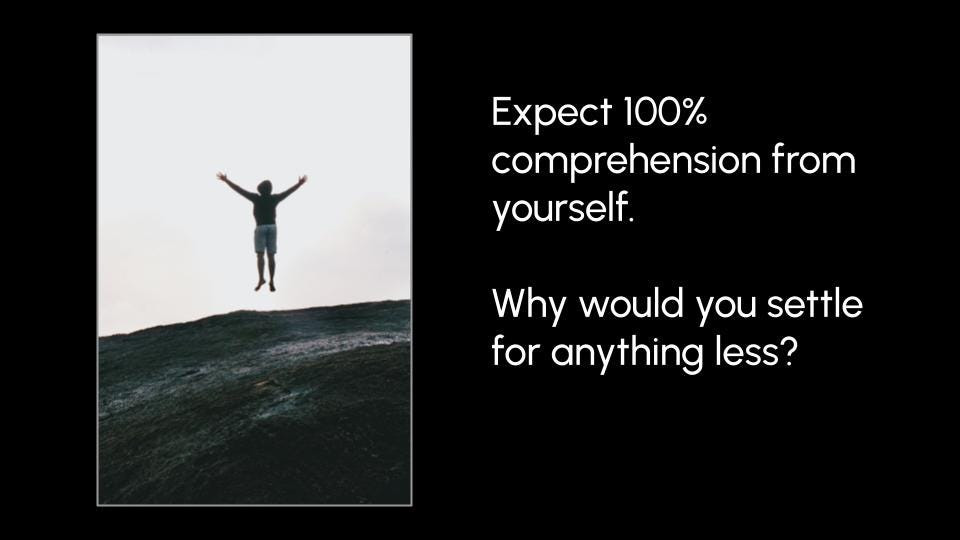
The next question is pedagogical: What does a "complete comprehension" lesson actually look like?
After many attempts to design “complete comprehension” lessons within conventional instructional frameworks4, often with reasonable success, I still found that my anticipation and planning always fell short. Although 100% correct anticipation is never the goal (like I mention in the hyperlinked post), I constantly wondered whether the parts I am missing are the parts that affect my students’ comprehension and reading growth adversely.
It was this persistent dissatisfaction that eventually led me to translation, which, in my opinion, is the simplest, most effective, and most efficient pedagogy for both dynamically assessing and ensuring complete comprehension in English Language Learners (ELLs).
I arrived at translation accidentally through my own attempts to learn Sanskrit, where translation is considered the principal demonstration of comprehension5. In the process, I began to notice striking parallels between my experience as a novice Sanskrit learner and that of students like Sainya who were early-stage ELLs:
We could understand very simple vocabulary and sentences in the target language, but struggle with formal text with unknown vocabulary in, say, textbooks. We struggle with coherent and grammatically correct expression, both oral and written, especially with ideas that require compound and complex sentence structures.
Through my studies and my work with students like Sainya, I found that we benefited immensely from separating the receptive and expressive goals of language learning. Attempting to pursue reading comprehension and speaking/writing simultaneously (as is done in most conventional lessons) was cognitively overwhelming and frustrating because our expressive language always lagged behind our receptive understanding.
I see no reason to postpone reading increasingly complex and interesting texts until our expressive language catches up with our receptive understanding. We are capable of understanding higher-level texts (with considerable effort), even when we are not yet capable of discussing or writing about them in the target language. Even if that catch-up never occurs, the pursuit of increasingly sophisticated comprehension is worthwhile and necessary.
Separating comprehension from expressive language does not mean abandoning expressive language. Expressive language can develop alongside at its own pace, perhaps even more systematically, with greater focus and accuracy, now that it is divorced from the simultaneous demands of comprehension.
Here’s the method I follow:
Pre-teach vocabulary from the text. (The best guide to do this, IMO, is Explicit Instruction by Anita Archer.)
Have the student(s) read the text aloud to me so I can gently correct miscues immediately and effectively.
Here’s an example of a text that I taught Sainya in March 2026. This is from Everyday English by Jane Sahi, the book I used as part of the curriculum with Sainya.
And this document shows the meaning-change miscues I corrected when she read it aloud for the first time.
Have the student(s) reread the text, if necessary, to improve fluency.
Reread the text aloud to the student(s) in meaningful chunks, pausing after each chunk. Sometimes the chunk is as long as a paragraph; at other times, it is only a phrase. I decide the length of a chunk based on both the student's capacity to comprehend information at one time and the structure of the text itself: its clauses, sentences, or paragraphs. A complex sentence containing multiple subordinate clauses may be broken into smaller chunks, whereas a simple paragraph with a single coherent idea may be translated in one go.
Ask the student(s) to translate each chunk into their home language. Provide corrections gently and effectively, paying close attention to the details. Ask questions for clarification along the way. Provide explanations, teach when required.
This is a list of Sainya’s misunderstandings as revealed by her translation. I am not aware of any other method of assessment or teaching that would have surfaced many of these errors.
Repeat until the text is completed.
Once comprehension is established through the process above, I shift the focus to expressive language while continuing to use the same text and a Q&A format. Early-stage learners like Sainya might need scaffolding over multiple stages.
I ask a question based on the text.
Oral Rehearsal
The student answers in a word/phrase/clause in the home language.
The student expresses the same idea in a word/phrase/clause in the target language.
The student attempts to produce a complete sentence in the target language.
I provide support as needed (supply words, correct word order, etc.) along with feedback.
The student repeats the revised answer, often several times, until she reaches a reasonable level of accuracy.
Writing
The student writes the rehearsed answer independently.
I provide support and feedback.
The student makes corrections to her answer.
Learning and Consolidation
The student learns (memorizes) the final answer at home.
An oral test is conducted 2-3 times over the next few days with immediate feedback.
A written test is conducted 2-3 times in the subsequent days with immediate feedback. If necessary, the student rewrites the answer with corrections.
The Learning and Consolidation stage is often dismissed by many of my colleagues as mere rote learning. But, when done correctly, it can provide students with repeated opportunities to practise sentence structures and vocabulary in the meaningful context of shared text. It can work as an essential component of English Language Learning.
I usually choose questions similar to those conventionally included at the end of chapters in State Board and NCERT textbooks.
To be doubly clear, I don’t follow this method for every single text. Looking back, I realize that I have ended up using it with approximately half the texts I taught Sainya.
I have found this method advantageous in the many ways:
Since I am proficient in Sainya’s home language (Kannada), the planning required for the classes has been less than what I otherwise do for conventional instructional paradigms. The most important part of the planning involves preparation for pre-teaching vocabulary and thoughtful chunking. I have found that much of the thoughtful chunking is better done on the spot than before the lesson because being attuned to the student in the moment greatly improves how well I chunk.
This method is also far more forgiving of planning errors than conventional lesson formats. Chunking errors, in particular, rarely disrupt the flow of the lesson or cause significant learning loss. The moment I realize that a chunk is too long or too short, I simply adjust on the spot and continue. This allows me to build comprehension far more reliably than lesson formats that require much longer feedback and course-correction cycles.
This method is not just extremely interactive; it is interactive in a meaningful way. With it, I have had to battle very little of the compulsive-teacher-pleasing-guessing disorder, which keeps my students stuck in useless reflexes: ‘What might be the correct answer?’ or ‘What does the teacher want me to say?’ instead of single-mindedly focusing on their comprehension of the text. Here, the students attempt to comprehend the text and express that comprehension in the language they know best. I support, sometimes just assist, this endeavour by providing corrections and helping them sharpen their understanding.
The students have ample talk time. Although most of it is in their home language rather than the target language, it keeps them active, engaged and awake, and reduces the passive listening that often accompanies prolonged teacher explanations.
As students use their home language extensively, it sharpens their command of the home language. The classroom becomes genuinely multilingual, allowing both the student and the learning environment to benefit from the many advantages of multilingualism.
Immediate and extensive feedback is built into the method. It is not something a teacher has to strive for separately or outside of class while battling extreme time constraints and will power. The teacher also doesn’t have to chase students to read/apply the feedback given to them. Plus, with the instant feedback loop, comprehension improves with every chunk.
Translation requires students to demonstrate their comprehension with a level of precision that teacher explanations rarely do. Such detailed and precise comprehension serves as the foundation for higher-order work such as literary analysis if required.
Since most methods rely on the target language itself to assess comprehension, a student's limitations in the target language often interfere with an accurate assessment of what they have understood. By allowing students to demonstrate comprehension in their home language, this method largely removes the influence of target-language deficits from assessment.
Errors in a student's translation provide the teacher with an immediate and clear idea of misconceptions, misunderstandings, and gaps in learning, much more than written answers that are often graded many days later. These errors can be addressed immediately or in subsequent lessons as per the teacher’s judgement.
This method allows me to assess and build comprehension more completely than any other method I have used.
This might be the right time to address the conditions under which this method does and does not apply:
This method requires the teacher to know the student’s home language (or at least the state language) with a high degree of proficiency. I am aware that many English teachers don’t.
Given the high degree of interaction and the reliance on home language, this method is probably only possible in a 1-1 setting or a small-group setting in which all students share a home language. I am aware that in most classrooms, small-group teaching is not feasible. I am also aware that in most classrooms, especially in cities, there are as many home languages in the room as there are students. However, in many settings, especially in rural India, students come from relatively similar linguistic backgrounds.
But there are many English teachers in the country who do know the home languages of their students, there are many educational contexts where small groups already exist, and many settings, especially in rural India, where students come from relatively similar linguistic backgrounds. Perhaps my work is applicable, and therefore useful, in those contexts. I believe this method can be adapted even to whole-class settings by exceptional teachers.
In the end, my conclusions extend beyond translation itself.
Students construct their own understanding of what "understanding" means from the demands our instruction places on them.
Therefore, instruction should require students to reveal the full extent of their comprehension rather than allowing it to remain hidden behind approximations, explanations, grades, or even correct answers.
The central problem, I have come to believe, is not just incomplete comprehension, it is invisible incomplete comprehension.
Translation is simply the best solution I have found so far.
The Simple View of Reading describes reading comprehension as the product of word recognition and oral language comprehension. Following this framework, complete comprehension may be defined as the ability to accurately recognize every word in a text and to understand every word, phrase, sentence, and paragraph, the text as a whole, and to draw valid inferences based on the information contained in the text.
In this post, comprehension does not refer to or include literary analysis. I will attempt to clarify the distinction between comprehension and literary analysis using an example. Consider the opening of Chapter 1 of Orwell’s Animal Farm.
Literal and inferential comprehension of this part of the text as addressed by questions such as:
Who is speaking? Who is listening? Why have the animals gathered? What does Old Major believe as the cause of the animals’ suffering? What does he want the animals to do? What do words such as tyranny, rebellion, comrade, miserable, and slaughter mean in context? What does such a life refer to?
And, all instances of word meaning, reference resolutions (Who does he refer to?), cohesion (What does instead connect?), temporal relations (What caused what?), sentence integration (Which earlier sentence explains this statement?), and other valid inferences based on the text.
Allegorical comprehension includes:
Old Major is not merely a pig giving a speech. He represents revolutionary thinkers (drawing heavily on Karl Marx and, to a lesser extent, Vladimir Lenin). The farm represents a political society rather than simply a farm. The rebellion represents political revolution rather than merely animals seeking freedom. Students should understand that Orwell is using the farm to talk about human societies, power, revolution, and ideology. Without this, they would have understood only one level of the book.
Most stories and books used in schools don’t need separate effort for such allegorical comprehension. But with this book, the lack of allegorical comprehension, in practical terms, amounts to not understanding the book.
Literary analysis as addressed by questions such as:
Why does Orwell choose pigs rather than another animal? How does Old Major's speech foreshadow later events? How does the narrative voice shape the reader's response? What is the effect of Orwell's diction? How does irony operate in the chapter? How does the speech function structurally within the novel? What makes the allegory artistically effective?
These are valuable literary questions, but they are not what I mean by comprehension in this post.
My definition of comprehension, as applied to Animal Farm includes literal, inferential and allegorical comprehension only, not literary analysis.
These questions gain even more significance today, when AI-generated summaries are increasingly treated as substitutes for one’s own comprehension of the original text, mostly without any attempt to verify their accuracy. (I am not even talking about the close reading required to detect bias, propaganda, omissions, or subtle distortions yet.)
School systems that are designed as a series of tasks assigned by adults without space for thinking, understanding and reflection often lead to mistaken conclusions in students about what is allowed or even possible. But that’s a discussion for another day.
Conventional instructional frameworks refer to common classroom comprehension models, typically including pre–during–post reading structures, teacher-led reading and explanation of texts, explicit comprehension instruction (e.g., modelling and guided practice), and strategy-based approaches.
Traditional Sanskrit pedagogy is not limited to translation and involves several stages such as
पदच्छेद (padaccheda) – segmentation of words
अन्वय (anvaya) – syntactic reordering into prose
पदार्थ (padārtha) – word-by-word meaning
तात्पर्य (tātparya) – intended meaning or purport
भाष्य (bhāṣya) and टीका (ṭīkā) – explanatory commentary