

In this post, I share a video explainer I made for a parent, B, whose 6-year-old child is struggling with spellings of “sight” words.
Let me begin with the spoiler right away: Sight words are a sham. Their existence relies on the assumption that 67 or 80 or 85% (depending on whom you ask) of English is “regular” or “phonetic.” Read this to free yourselves from the myth. In Dr. Gina Cooke’s words, “exceptions or irregular words or sight words or learned words or red words or heart words or demon words or broken words or any of the other silly-named words are words the author doesn’t understand/cannot explain.”
B’s daughter has been exclusively taught phonics (unfortunately, the worse kind found predominantly in Montessori schools in India, in which “sounds” are used to identify letters; letter names are not taught for about two-and-a-half years, post which the child is miraculously expected to just learn them and transition out).
The school is now sending home 8 “sight” words per week. Parents are expected to get the child to “practise” the words; the child is expected to take a test at school at the end of the week. The child, S, is scoring no more than 3 marks every week. The school has already made two phone calls to the mother asking her why she’s not getting S to practise enough. The implicit diagnosis and subsequent conclusions are clear: S needs more practice.
Here’s what B told me this morning: “S is writing the same word repeatedly, but even after 10-15 times, she said v-e-r-y when I asked her for the spelling of ‘why’.”
Practice isn’t helping S. It won’t either. She is confused. Look at the list of words from the last 4 weeks.
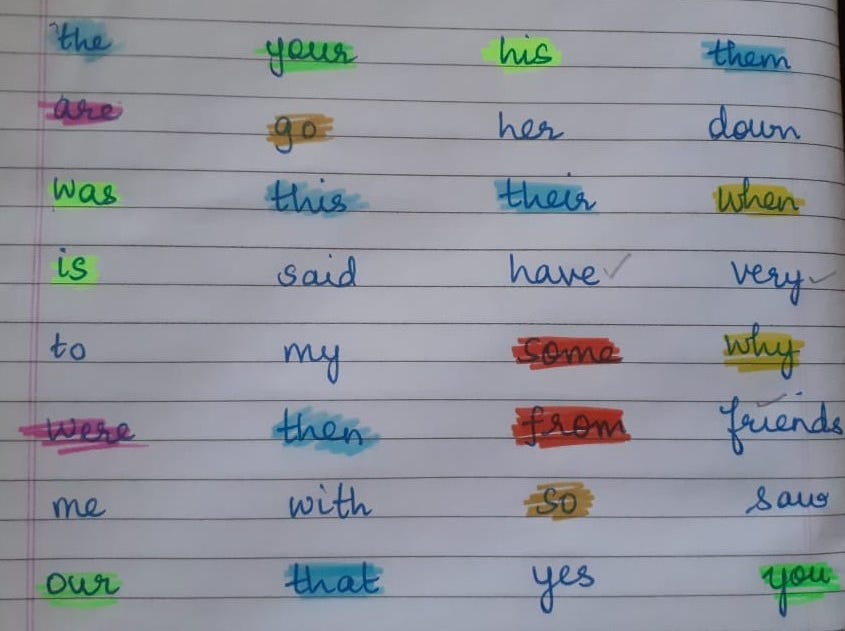
The lists are the antithesis of ‘systematic’.
After years of complete reliance on phonics - to the extent that parents were discouraged from teaching S letter names - the school has unleashed a sudden onslaught of these “sight” words with support only in the form of continuous pressure to “just practise and remember”.
Since she was 4, S was dependent on the “logic” of phonics to read the controlled texts she was carefully exposed to. In about a couple of weeks all her previous knowledge and logic have suddenly ceased to help, as if a rug has been pulled from under her. She’s trying hard to figure out when she must apply phonics, when she must rely on her unstable memory, and in the process, is now getting even the so-called “phonetically regular” words wrong. These are words she was confident about before and is shocked and frustrated at her own repeated errors. So are the parents. She’s slowly resorting to guessing, a coping mechanism that make complete sense if the English spelling system was erratic as it currently appears to her.
S has also been sensing pressure from school and is watching her older brother score better on his weekly dictation. Last week, she said to her mother, “Maybe I’ll score more marks once I become big like anna?” Poor S doesn’t need to age; she needs to be taught more systematically and her questions need to be answered even when she can’t articulate them sometimes.
Since about a week, she has been refusing to participate in anything to do with spelling. She’d rather not try than face repeated failure. I’m not surprised; what else do you expect with faulty instruction followed by faultier diagnoses and interventions?
I did what I have learned from Dr. Gina Cooke and tried to find patterns in the chaos. In about 5 minutes, we learned 4 of the light-blue words by addressing her confusion. I sent the same explanation/activity to the mother so that she can follow up, and more importantly, support this understanding.
If the fallout of bad teaching was only intellectual, it would be far easier. I’d be able to quickly debunk misunderstandings and help the child see logic and facts. Unfortunately, bad teaching coupled with high stakes environments and high expectations leads to an unnecessary experience of failure, self-doubt, panic and anxiety even to children as young as 6 years (and of course their parents). It’s hard work to get a little child to see that
her teacher may not have given her complete information even though she is wonderful (S loves her teacher to the moon and back.);
I can share information that will make it easier for her;
she is not dumb or slow or lesser than others who are getting most spellings right;
there is value in practice only when understanding precedes it;
she can trust me about helping her understand the words;
if she gives me her undivided attention without trying to somehow get away from the task at hand, I can explain what appears complicated and unachievable in less than 2 minutes;
and more
This is harder especially when there’s constant pressure from school about the expectations of first grade, when they keep directly and indirectly letting the parent know that terrible times are only one less practice session away.
In the next few weeks, I plan to tackle the lists given by the school in a systematic way that honours both the true nature of English orthography and the developmental needs of S. This is what I have done with many other students who have had similar struggles, and they’ve come out the other end of the scary tunnel of confusion and failure with confidence and joy.
In the meantime, I hope the video is useful to someone else in a similar predicament.
Thank you for being one of my readers; I appreciate you very much! If you’d like to support my work you can do so by:
Liking this post, so that others are encouraged to read it;
Leaving a comment;
Sharing this post by email, WhatsApp, or on social media;
Subscribing to this substack;
Currently, Substack is not supporting payments to many Indian writers including me. Click here to pay me directly via UPI or PayPal to access paid content.
Sponsoring my work with students who cannot afford to pay fees.